Organisational psychology
Organisational psychology: a practical team guide
A practical guide to organisational psychology for digital teams: understand friction, clarify decisions and improve how people work together.
A team can have capable people, sensible goals and good software, yet spend its week waiting for answers. One colleague avoids raising a concern. Another keeps checking a decision that should already be settled. A manager asks for ownership while approving every small change.
Organisational psychology gives you ways to examine these situations without reducing them to personality. It studies how people think, act and relate at work, alongside the structures shaping those behaviours. For a digital team, the useful question is concrete: what in this working environment makes the behaviour we need easier or harder?
This guide is for people leading projects, products and change. It offers a method for looking at team friction and choosing a manageable response. It does not turn a manager into a psychologist, and it is not a substitute for specialist assessment of workplace health or serious interpersonal problems.
Start with a work episode, not a label
“The team lacks motivation” sounds like a diagnosis. Usually it is a summary of several unexplained observations. Which task is slipping? Who had the information? What happened when someone requested help? What did the organisation reward?
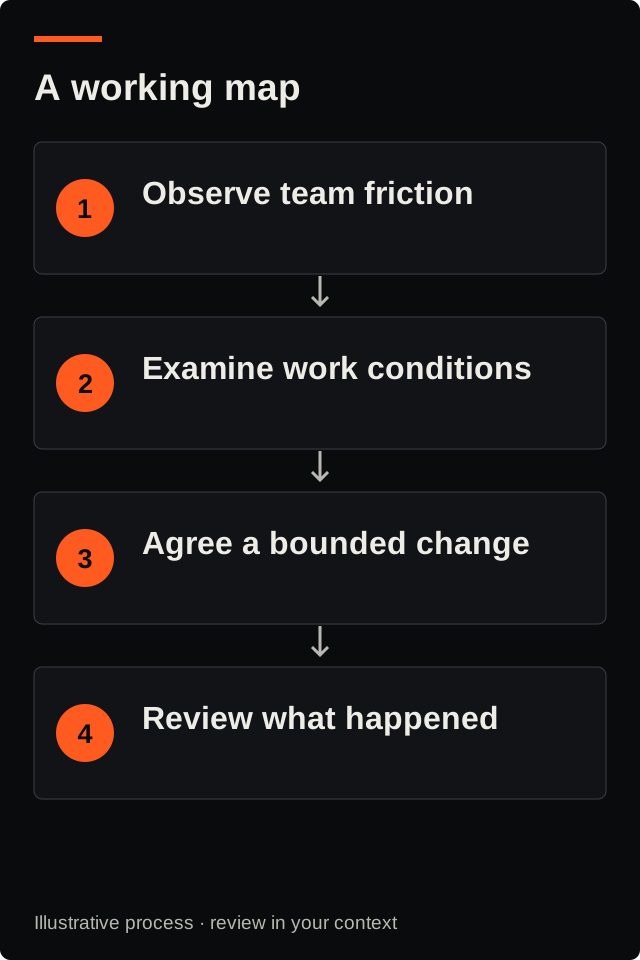
Pick a recent episode with a clear beginning and end. Map the request, the handover, the decision and the outcome. Separate what happened from your interpretation. “The reviewer replied after the deadline” is an observation. “The reviewer does not care” is a judgement about a motive you have not established.
Speak to the people involved before selecting a remedy. Ask them to reconstruct the work, including uncertainty and constraints. A person may have delayed because three managers supplied different priorities. A training course on resilience would leave that conflict intact. A shared priority decision could address it directly.
Keep the unit of analysis proportionate. One missed handover needs a discussion. A recurring pattern across functions may need a process change. Neither warrants casually assigning a psychological label to an individual.
Examine the person, the task and the system together
People bring skills, expectations and previous experiences to work. Tasks bring complexity, dependencies and deadlines. Organisations distribute resources, authority and consequences. Useful analysis examines their interaction.
For example, a capable analyst may be new to an unfamiliar data source. The task requires careful interpretation; the team treats any request for clarification as weakness. The problem cannot be explained by ability alone. You need to inspect the task support and the response to uncertainty.
Use three lenses when reconstructing an episode:
Swipe or use the arrow keys to see every column.
| Lens | Questions to ask | Evidence to collect |
|---|---|---|
| Person | What did this person know, and what help could they request? | Task experience, access to guidance, their account of the episode |
| Task | What made the work difficult or ambiguous? | Dependencies, acceptance criteria, missing information |
| System | Who could decide, and what consequences followed? | Approval rules, competing priorities, rewards and escalation routes |
The table is a thinking tool, not a validated diagnostic instrument. Its purpose is to prevent the most convenient explanation from becoming the only explanation.
Make interpersonal risk visible
When someone sees a problem, speaking up can carry a cost: embarrassment, an argument or fear of being judged. Amy Edmondson’s research on psychological safety examined its association with team learning.
The practical implication I draw is to inspect the response to difficult information. What happens after someone admits an error? Does the meeting investigate the conditions, or immediately search for a person to blame? Can a junior colleague question an assumption before the senior person has declared a preference?
Psychological safety does not remove standards. A team still needs clear commitments, competent work and consequences for harmful behaviour. It makes it possible to discuss the information needed to meet those standards. The detailed guide to psychological safety in teams explains how to practise that distinction in meetings and reviews.
Distinguish autonomy from abandonment
“You own this” means little if the person cannot choose a method, access a resource or refuse an incompatible request. Equally, leaving someone alone with an unfamiliar task is not a thoughtful form of autonomy.
Ryan and Deci’s account of self-determination theory identifies autonomy, competence and relatedness as psychological needs. It is a useful reference point; it does not promise that a particular management technique will improve every team.
Translate the idea into work design. Clarify the outcome and constraints. Agree which choices belong to the person doing the work. Provide support without taking back the task every time a question appears. Make useful feedback available while there is still time to act on it.
If every decision returns to you, examine the permission structure before asking for more initiative. The guide to motivation and autonomy at work offers a worksheet for doing that.
Reduce avoidable effort before adding another tool
A team can be busy because the work is demanding or because the environment repeatedly interrupts it. Those require different responses. A complex decision may deserve more thinking time. Searching three chat channels for the current requirement may deserve a better record.
Look for information people must remember, reconcile or repeatedly request. Put the decision, owner and current version where the work happens. Remove duplicate status reporting. Specify which messages require immediate attention and which can wait.
The team cognitive load guide develops this distinction without claiming that classroom learning research gives a direct productivity formula for the workplace. The aim is to reduce needless reconstruction while preserving the challenge that belongs to the task.
Treat disagreement as information that needs a process
Two people can disagree about a product launch without having a relationship problem. They may be weighing different risks. Yet a discussion can become personal when criticism of a proposal is heard as criticism of its author.
Make the disputed decision explicit. Ask what evidence each position uses and what would change it. Agree who decides if the disagreement remains. Do not require public consensus on every issue, and do not encourage conflict for its own sake.
The article on task and relationship conflict separates these situations and explains when a manager should pause the discussion or involve the appropriate organisational support. A clever facilitation exercise is not an adequate response to intimidation or harassment.
A hypothetical team: fixing repeated approval delays
Imagine a product team preparing a new customer onboarding flow. This is a hypothetical example, not a client case. Designers wait for approval; the project lead sees missed deadlines; the commercial team keeps requesting changes.
An initial explanation is that the designers lack confidence. Mapping the work reveals something else. The commercial director can change scope, the product lead owns the deadline, and nobody has authority to reject a late request. Designers are also criticised when they make assumptions about incomplete requirements.
The team tries one bounded change. A named product owner decides which late requests enter the current release. The brief includes acceptance criteria. A scheduled review gives designers a place to surface unresolved questions before final approval. Urgent exceptions have a separate route.
The team watches approval waiting time, repeated revisions and the reasons for exceptions. It also asks whether the new arrangement creates pressure to hide concerns. The example has no promised outcome: the process might reveal a capacity shortage rather than solve the delay. Its value is making the next decision easier to assess.
Use this team-friction worksheet
Choose one recurring problem and complete the worksheet with the people who experience it. Keep the language specific enough that somebody else could recognise the episode.
Swipe or use the arrow keys to see every column.
| Field | Write down | Example from the hypothetical team |
|---|---|---|
| Desired behaviour | What needs to happen differently? | Raise uncertain requirements before final design approval |
| Present obstacle | What makes that difficult? | Conflicting requests and criticism for asking questions |
| Structural change | What can the team alter? | One scope owner and a scheduled question review |
| Support | What does the person need? | Access to the owner and examples of accepted work |
| Evidence | What would suggest improvement or harm? | Fewer repeated revisions; concerns still being raised |
| Review decision | When and how will you reassess? | Review after a complete release cycle |
Do not turn the worksheet into a score for comparing employees. It describes a work arrangement. Avoid collecting personal or sensitive information simply because a form has space for it. Tell participants who will see the notes and what decision the discussion informs.
Culture and trust are built in everyday responses
Values become credible when people can point to actions supporting them. If a company says it values learning but rewards only flawless delivery, employees face competing signals. Explore organisational culture through behaviours by examining promotion, handovers, errors and exceptions.
Trust also needs more than friendly contact. People need to understand whether colleagues can deliver, will communicate problems and will respect agreed boundaries. In hybrid work, make these expectations explicit rather than using presence or reply speed as a proxy for reliability. The guide to trust in hybrid teams shows how.
When introducing AI, use the same lenses. Resistance may point to unclear responsibility, weak training or a genuine concern about an output. The article on resistance to AI change gives you a way to investigate these objections before choosing the response.
What to do this week
Select one episode. Talk to the people involved. Draw the path from request to decision. Choose one change that you have authority to make, name its owner and agree a review point. Record what would persuade you that the change is creating a new problem.
Keep the first intervention small enough to reverse. Team-level before-and-after observations can support learning, but they do not automatically establish causality. Changes in workload, staffing or project difficulty may explain part of what you see.
The same discipline applies when studying customers: the consumer psychology guide separates observed actions from explanations. Understanding behaviour starts with a better question, then requires evidence.
If an AI or digital programme is getting stuck between people, decisions and working practices, tell me where the handover breaks down. We can examine the work arrangement and define a practical next step.
Apply this to your project
Tell me the decision you are facing, the constraints and what you have already tried.
Keep exploring
Resistance to AI change: understand the objection
Understand resistance to AI at work: separate valid risks from missing skills, clarify responsibilities and design a pilot people can evaluate.
Motivation at work: give autonomy a clear shape
Understand motivation and autonomy at work: clarify choices, support competence and design responsibilities people can exercise in practice.
Organisational culture: look at everyday behaviour
Understand organisational culture through decisions, rewards and everyday responses, then turn stated values into working practices you can review.